Property Maintenance Triage
Tenant reports a leak, the agent triages it, prices it, picks a contractor and puts one decision in front of the landlord.
The problem
A tenant messages "there is water coming through the kitchen ceiling" at nine on a Sunday night. What follows is a chain of small delays: someone reads it Monday, asks the tenant three follow-up questions, works out whether it is urgent, finds a plumber, gets a rough price, and asks the landlord to approve.
None of those steps is hard. All of them are waiting. And the cost of the delay is not admin time — it is the ceiling.
What I built
An agent that takes the tenant message in whatever form it arrives, classifies the trade and urgency, produces a plain-English summary, estimates a rough price band from the trade and risk language, and recommends a contractor and a dispatch mode.
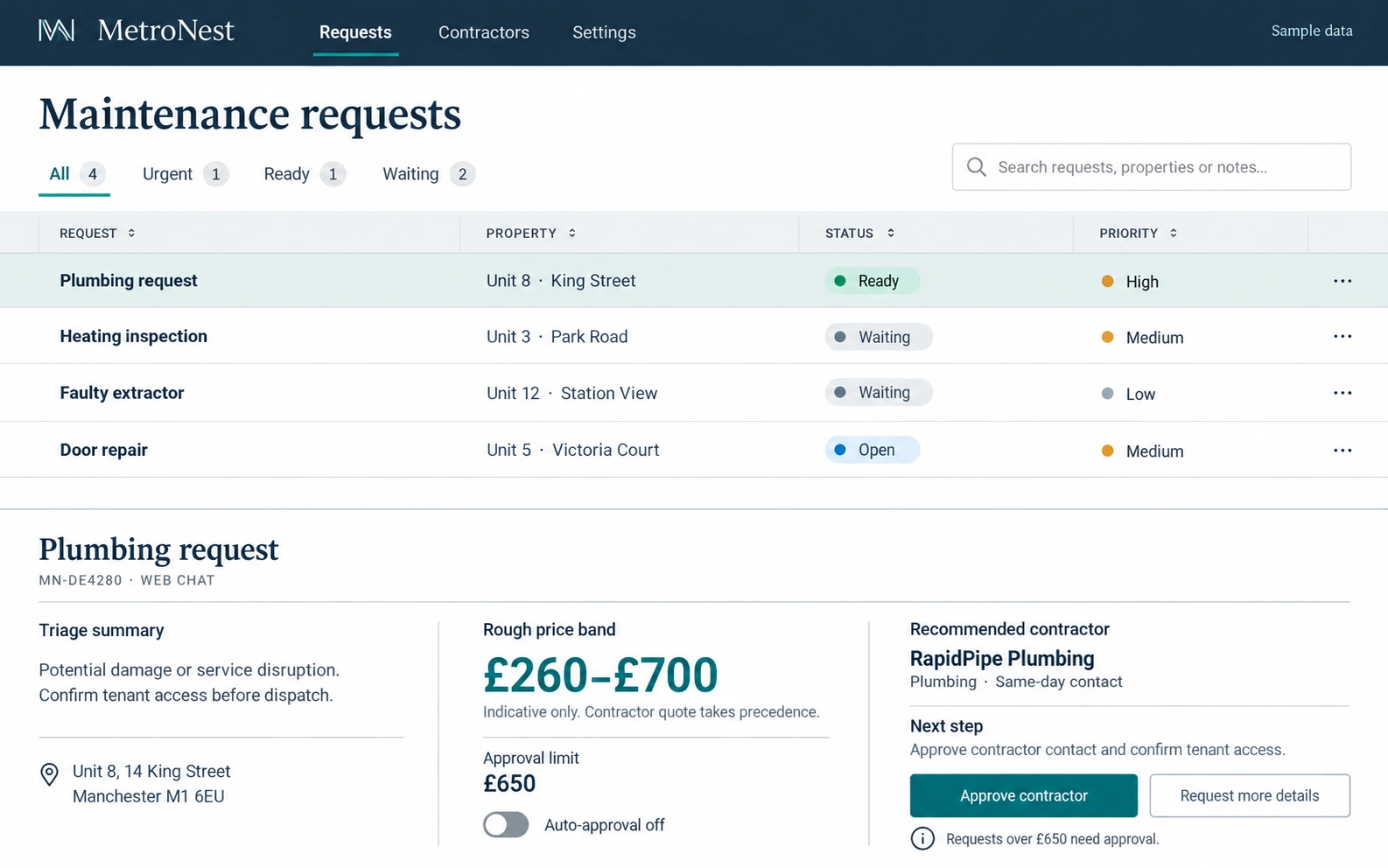
The landlord sees one card with one decision on it. There is an approval rule with a quote limit, so anything urgent under the limit can be auto-accepted and anything above it waits for a human. The point is not to remove the landlord, it is to remove the four messages that used to happen before the landlord could decide anything.
Requests move across a status board — open, urgent, ready, waiting on tenant info — so the thing that is stuck is visible rather than sitting in somebody's inbox.
Project access
A private prototype with no public demo. The image is an interface redesign concept using sample data; the original prototype workflow is described below.
What changed
The prototype brings the request, triage summary, indicative price and next action into one view. The status board makes requests awaiting tenant information visible alongside jobs ready for a decision.
- Decision to make
- 1
- Under quote limit
- Auto
Next project
Fitness Tracking App
One place to log sessions, follow the week, and see progress — instead of rebuilding the system every Monday.
What are we building?
An app, a better way of working, or an AI integration. Tell me where you’d like to start.